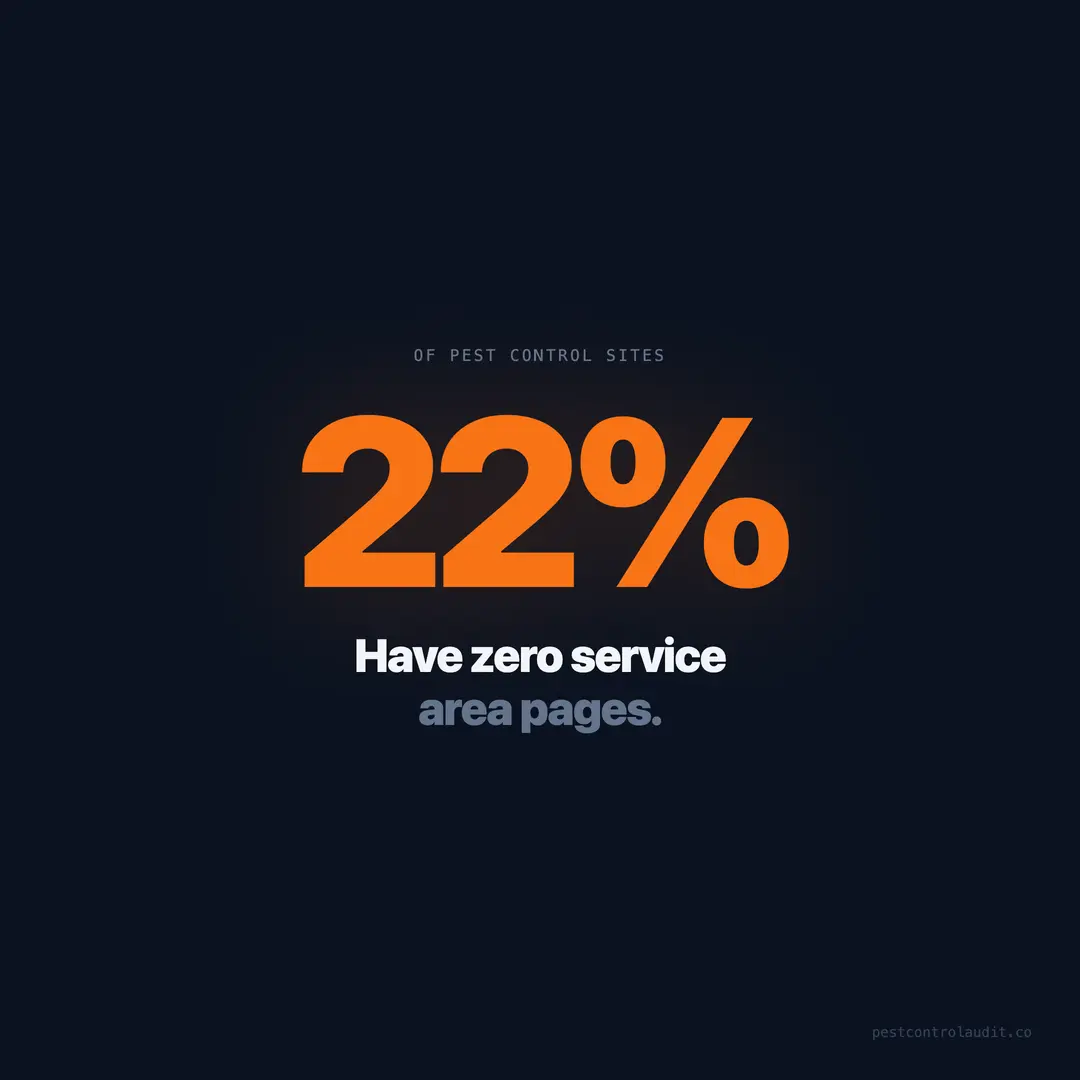
22% of Pest Control Sites Have No Service Area Pages
327 of 1,537 pest control sites have no city-specific pages. Without them, you're invisible for every local pest control search in your area.
A homeowner in Orange Park, Florida — 15 minutes south of Jacksonville — searches “pest control Orange Park FL.” Google returns three map results and ten organic links. None of them are yours. Not because you don’t serve Orange Park. You do. But your website never mentions it.
Your competitor, who built a dedicated Orange Park page six months ago, takes that call. And every Orange Park call after it.
When we audited 1,537 pest control websites across 12 states, 22% — 327 companies — had zero service area pages. No city-specific content. No local landing pages. Just a single contact page with an address and a hope that Google would figure out the rest. Google doesn’t figure it out. Google matches queries to pages. No page for Orange Park means no ranking for Orange Park.
Service area pages are the backbone of local SEO for service businesses. This post covers why 327 pest control companies are missing them, what these pages should contain, and how to build them without burning a month of your time.
Local Searches Need Local Pages to Match
327 sites — 22% of our 1,537-site dataset — have no dedicated pages for the cities they serve. These companies rely on their physical address and Google Business Profile to establish their service area. That’s not enough.
Google processes local searches by matching query intent to page content. When someone searches “pest control in Scottsdale AZ,” Google looks for pages that specifically mention pest control in Scottsdale. A generic “Our Services” page based in Phoenix won’t match that query — even if you drive to Scottsdale every day.
The 78% of sites that do have service area pages capture city-specific searches across their entire territory. A company serving 10 cities with 10 dedicated pages competes for 10x more local keywords than a company with zero city pages. It’s that simple.
Among the top-scoring sites in our audit — those above 60/100 — nearly all had 10 or more service area pages. Among sub-20 sites, city pages were almost universally absent.
What Belongs on a Service Area Page
A service area page isn’t a copy-paste of your homepage with the city name swapped in. Google penalizes thin, duplicate content. Each page needs unique, locally relevant information.
The Core Structure
Every city page should have: the city name in the title tag and H1, a description of your pest control services in that area, the specific pests common to that location, your phone number (clickable, with tel: link), a contact form or CTA, and a mention of neighborhoods or zip codes within the city.
A page for “Pest Control in Orange Park FL” might lead with: “We serve Orange Park and the surrounding areas including Fleming Island, Middleburg, and Green Cove Springs. Common pest issues in the Orange Park area include subterranean termites, fire ants, German cockroaches, and roof rats.”
That’s specific. That’s useful. That’s what Google wants to show for “pest control Orange Park.”
Local Pest Information
Every region has different pest pressures. Florida has year-round termite activity. Arizona has scorpions and bark beetles. North Carolina has seasonal ant invasions. The content on each city page should reflect the local reality.
This isn’t hard to write. Your technicians know what pests are most common in each area. Ask them. Turn their answers into two paragraphs of unique content per city page.
Service-Specific Details
Don’t just say “we offer pest control.” List the specific services available in that city: general pest treatment, termite inspections, bed bug heat treatment, rodent exclusion, mosquito barrier programs, wildlife removal. Use the terminology homeowners actually search for.
The Service Area Gap by State
The 22% national average masks state-level variation. Markets with higher competition tend to have better service area coverage, because agencies in those markets push city pages as a local SEO strategy.
Florida had the lowest gap at about 19% of its 375 sites — still nearly one in five, but better than the national average. The state’s intense competition, particularly in metro areas like Jacksonville (48 sites), pushes companies toward local SEO strategies.
Arkansas (20 sites) had the highest gap at about 30%. Oklahoma (62 sites) was at 28%. Alabama (67 sites) at 27%. Smaller markets face less competitive pressure, so the urgency to build city pages doesn’t feel as strong. But the flip side is that fewer competitors means each city page has a better chance of ranking — the opportunity is actually larger.
How Many City Pages You Need
The answer depends on how many cities you actually serve. But the principle is simple: if your technicians drive there, you need a page for it.
A company serving a metro area and its suburbs might need 10-20 pages. A company serving a large rural territory might need 5-10 covering the major towns. The top-performing sites in our audit had between 15 and 30 service area pages.
Don’t go overboard. If you create 50 city pages for places you barely serve, Google will see thin, low-quality content. Focus on cities where you have real service capacity, can respond same-day, and have technician familiarity.
Prioritize by Search Volume
Not all cities generate equal search volume. Use Google’s Keyword Planner or a free tool like Ubersuggest to check monthly searches for “pest control [city]” in your target areas. Start with the highest-volume cities and work down.
For example, in the Jacksonville metro, “pest control Jacksonville” has far more monthly searches than “pest control Fleming Island.” But Fleming Island has less competition, so your page might rank faster. Build both — start with the high-volume city, then expand to suburbs.
The Link Between City Pages and Map Pack Rankings
Service area pages don’t replace your Google Business Profile for map pack rankings. But they support it. Here’s how.
When Google evaluates which businesses to show in the map pack for “pest control Orange Park,” it considers relevance, proximity, and prominence. Prominence includes signals from your website — like having a dedicated Orange Park page with relevant content, schema markup, and consistent NAP data.
A website with a dedicated Orange Park page tells Google: “This business explicitly serves Orange Park.” A website with no mention of Orange Park tells Google nothing. The first business gets a relevance boost. The second doesn’t.
Companies in our audit with service area pages consistently scored higher overall. They weren’t just winning on city page points — the presence of local content improved their entire site’s relevance signals.
Common Mistakes With Service Area Pages
We’ve seen service area pages done badly. These mistakes can hurt more than having no pages at all.
Copy-Paste Content With City Name Swaps
The biggest mistake: creating 20 pages with identical content except for the city name. Google recognizes this pattern instantly. It’s thin content, and it may trigger a quality penalty that hurts your entire site.
Each page needs unique content. Different local pest pressures, different neighborhood details, different seasonal notes. Yes, it takes more time. But 10 unique pages are worth more than 30 duplicate ones.
No Internal Links
City pages need to link to your main service pages and vice versa. Your termite treatment page should link to the city pages where you offer termite treatment. Your Jacksonville page should link to your termite, rodent, and general pest pages. This creates a web of internal links that helps Google understand your site’s structure.
Missing CTA
A city page without a call-to-action is a dead end. Every city page needs a phone number, a form, or a “Get a Quote” button. The visitor arrived because they’re looking for pest control in their city. Make it easy to convert.
Building 10 City Pages in a Weekend
Here’s a realistic timeline. Dedicate a Saturday to your first batch of service area pages. Two hours of research, six hours of writing. That gives you 10 pages averaging 500-700 words each with unique local content.
Create a template structure: city name H1, introduction paragraph with local pest info, services list with links to main service pages, neighborhood and zip code coverage, CTA with phone and form. Then fill in the unique details for each city.
After publishing, submit the updated sitemap to Google Search Console. New pages typically get indexed within a week. Rankings build over weeks and months as Google evaluates the content quality and user engagement.
The 327 companies with no service area pages are giving away local search traffic every day. If you’re one of them, this is one of the highest-ROI fixes available. See your full audit to find out what else is missing.
Keep Reading
- We Audited 1,537 Pest Control Websites. Here’s the Data. — The complete data set with all gaps.
- 26% Have the Wrong Phone Number on Google — NAP consistency matters across every city page.
- The Pest Control Website Checklist (2026) — Service area pages are one of 13+ criteria.
Want to know your score?
Drop your URL — full report in 48 hours.
We're on it.
Report in your inbox within 48 hours.