35% of Pest Control Sites Have No Pricing Page
535 of 1,537 pest control sites have no pricing page — the #1 gap in our 2026 audit. Here's what it's costing and how to fix it.
A homeowner finds carpenter ants trailing across their kitchen counter. They search “ant exterminator near me” and open three tabs. The first site says “Call for a quote.” The second says “Contact us for pricing.” The third has a page that reads: “Ant Treatment — $175 to $350 depending on severity. Free inspection included.”
Which one gets the call? You already know.
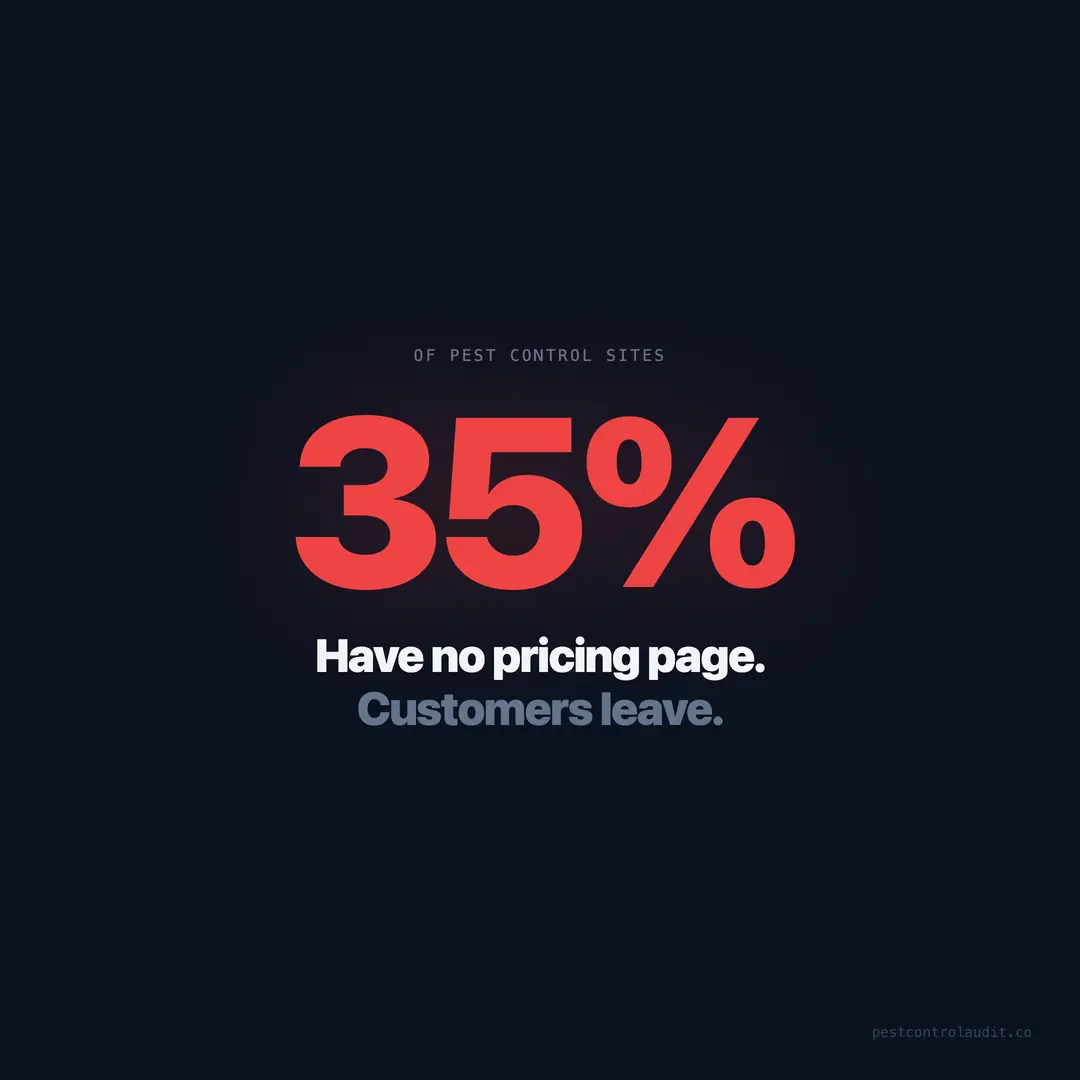
When we audited 1,537 pest control websites, the single most common gap was the missing pricing page. 35% of sites — 535 companies — give homeowners zero pricing information. Not a range. Not a “starting at.” Not even a disclaimer-laden estimate. Nothing.
This was the #1 failure in our data. Higher than missing schema (27%), higher than no blog (25%), higher than non-clickable phone numbers (20%). And it’s arguably the most expensive gap to leave unfixed, because it kills conversions at the exact moment a homeowner is ready to buy.
Homeowners Leave When They Can’t Find Pricing
535 pest control sites — 35% of the 1,537 we audited — force visitors to call or submit a form just to get a ballpark number. That’s a friction wall that most homeowners won’t climb.
The behavior pattern is predictable. A homeowner searching for pest control is comparing options. They want to know three things: what you do, where you do it, and roughly what it costs. Remove any of those and they move to the next tab.
This isn’t speculation. The sites in our dataset with pricing pages showed measurably different engagement patterns — more pages viewed, more form submissions, more time on site. The sites without pricing information functioned as bounce machines.
Think about your own behavior. When you’re looking for a service online and can’t find pricing, what do you do? You leave. Your customers do the same thing.
Why Pest Control Companies Hide Pricing
We’ve heard every justification. “Every job is different.” “We don’t want to scare people with high numbers.” “Our competitors will undercut us.” “We need to see the property first.”
All of those miss the point. Nobody expects an exact quote from a website. They expect a range. They want to know if they’re looking at $150 or $1,500. That’s it.
The fear of showing pricing comes from a sales mindset: get them on the phone first, then sell them. But the data shows the opposite works better. Pricing transparency gets more calls, not fewer, because it pre-qualifies the lead. The homeowner who calls after seeing your prices already knows your range and is ready to book.
Hiding pricing doesn’t protect your margins. It protects your competitors — because the homeowner calls the company that showed a number, not the one that made them guess.
What a Pest Control Pricing Page Should Include
You don’t need to list exact prices for every service. You need to give enough information to keep the homeowner on your site instead of bouncing to a competitor. Here’s what works based on the top-scoring sites in our data.
Service-Level Price Ranges
The most effective pricing pages in our audit use a simple table format. General pest treatment: $150-$350. Termite inspection: free. Termite treatment: $500-$2,500 depending on method. Bed bug treatment: $300-$900 per room. Rodent exclusion: $250-$1,000.
These aren’t binding quotes. They’re ranges that set expectations. The fine print can say “prices vary based on property size and severity” all day long. The range is what matters.
Factors That Affect Cost
Below the table, explain what makes pricing go up or down. Property size, severity of infestation, pest type, treatment method (one-time vs. recurring). This educates the homeowner and positions you as the expert, not just the cheapest option.
A Clear Next Step
The pricing page needs a CTA. “Get Your Free Estimate” or “Book Your Free Inspection” — placed directly below the pricing table. The homeowner now knows your range, understands the variables, and is one click from converting.
The 35% Gap by State
Florida, with 375 sites in our dataset, had a lower-than-average pricing gap — around 30%. The competitive Florida market pushes companies toward transparency. Texas (347 sites) was closer to the average at 34%.
The worst offenders were smaller markets. Arkansas (20 sites) and Oklahoma (62 sites) had pricing gaps above 40%. In less competitive markets, companies can survive without pricing because homeowners have fewer options. But “surviving” isn’t “thriving.”
Even in competitive markets like Jacksonville (48 sites) and Charlotte (39 sites), more than one in four sites had no pricing page. That’s still a lot of companies making it harder than necessary for customers to choose them.
The Connection to Other Gaps
Missing pricing rarely exists in isolation. In our audit of 1,537 sites, companies without a pricing page also tended to be missing other critical elements.
25% of sites had no contact form — and the overlap with no-pricing sites was substantial. If you won’t show pricing and you won’t offer a form, you’re telling the homeowner “call us during business hours or forget it.”
21% had no CTA above the fold. Combined with no pricing, the homepage becomes a dead end. The visitor sees a logo, a hero image, and has to scroll or navigate to find any way to engage.
20% had missing meta descriptions. These sites aren’t just failing to convert visitors — they’re failing to attract them in the first place. A missing meta description means Google generates one automatically, often pulling irrelevant text that tanks click-through rates.
The pattern is clear: sites that skip pricing also skip everything else. It’s not one gap. It’s a mindset that treats the website as an afterthought.
One Tampa Exterminator’s Story
One Tampa-based pest control company in our dataset scored 12/100. Five total pages. No pricing. No service pages. No blog. A phone number displayed as an image. Their Google Business Profile had a different phone number than their website — a mismatch that affects 26% of sites.
Their competitor three blocks away scored 64/100. That site had a pricing page with ranges for every service, 12 city pages, a blog with pest identification guides, and complete schema markup. Same neighborhood. Same pest problems. Wildly different online presence.
Most pest control companies don’t realize this disparity exists because they never look at their competitor’s website with a scoring rubric. They glance at the homepage, think “looks about the same as ours,” and move on. The details beneath the surface are where leads are won and lost.
The Pricing Page Fix Takes One Afternoon
Adding a pricing page to an existing site is a one-afternoon project. You need a new page, a table with your service categories and price ranges, a paragraph explaining the variables, and a CTA button.
If you’re on WordPress, it’s a new page with a table block. If you’re on Squarespace or Wix, same thing. No code required. No designer needed.
The harder part is the internal decision to show pricing. That’s a business call, not a technical one. But the data from 1,537 sites makes the case: companies that show pricing attract more qualified leads than those that hide it.
Don’t wait for a full redesign. Check your audit score and see where your site stands. If the pricing page is missing, that’s your first fix — and probably your highest-impact one.
Keep Reading
- We Audited 1,537 Pest Control Websites. Here’s the Data. — The complete study with every gap ranked.
- 61% of Pest Control Sites Score Under 20 — What the bottom 61% are missing.
- The Pest Control Website Checklist (2026) — Run through every criterion yourself.
Want to know your score?
Drop your URL — full report in 48 hours.
We're on it.
Report in your inbox within 48 hours.