Cost Per Lead: Your Website vs Angi vs Thumbtack
Website leads cost $5-20 long-term. Angi leads cost $60-85 each. A breakdown of cost per lead across every channel pest control companies use.
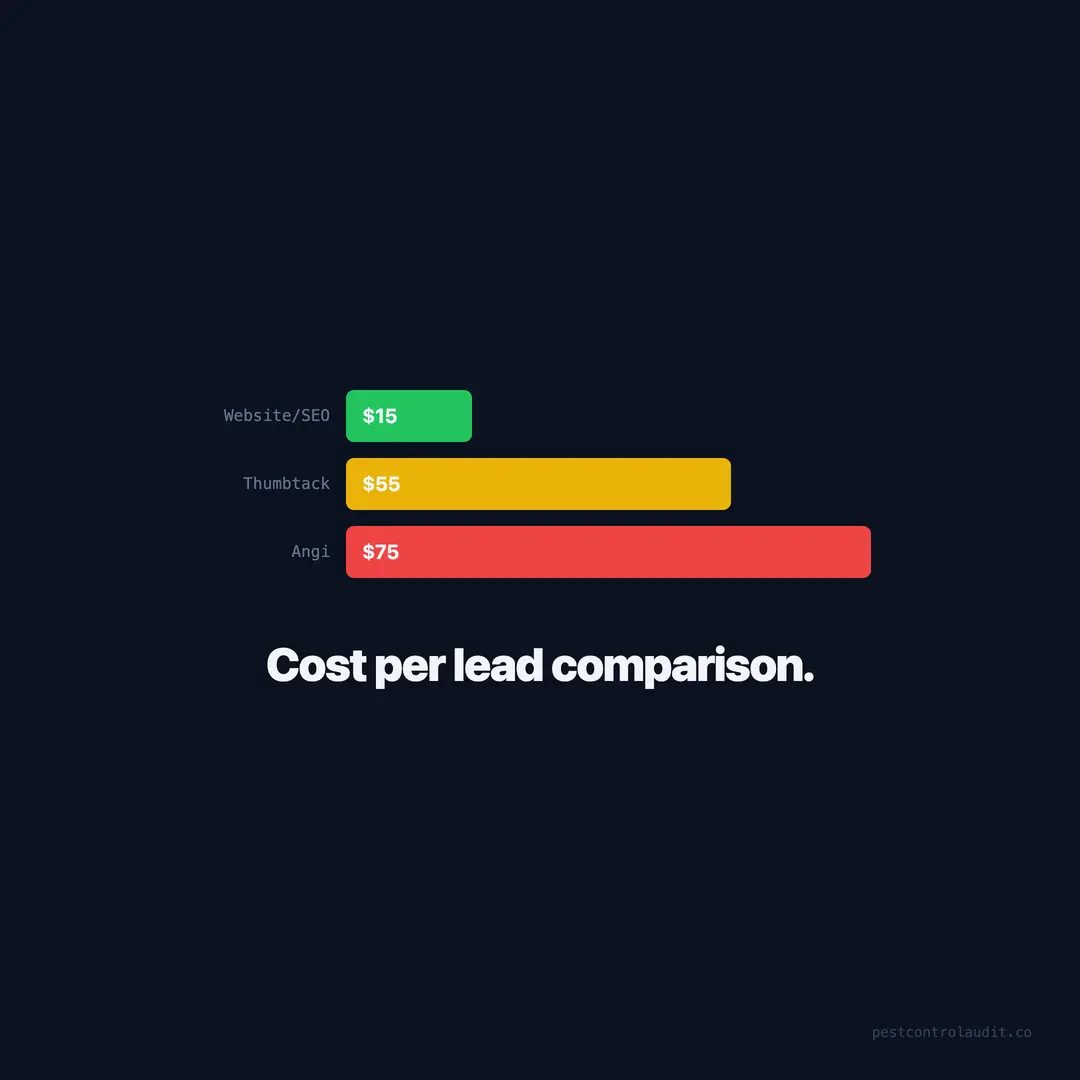
A pest control company in Orlando spends $2,400/month on Angi leads. They get 35 leads per month — $69 each. Their close rate on Angi leads is 18% because the homeowner contacted three other companies simultaneously. That’s 6 jobs at $350 average. Gross revenue: $2,100. They’re spending $2,400 to make $2,100. They’re losing money and calling it marketing.
Website leads cost $5-20 each over time, while Angi leads average $60-85 and Thumbtack leads run $30-75 per contact — and our audit of 1,537 pest control sites found that the average site scores just 21/100, meaning most companies’ websites aren’t competing at all. The result: 61% of the industry is trapped paying premium prices for shared leads on platforms they don’t control, because their own websites can’t generate leads independently.
This breakdown compares cost per lead across every major channel pest control companies use, using actual pricing data and conversion math.
Platform leads are expensive — and getting more expensive every year
Angi’s cost per lead for pest control averaged $60-85 in 2025 (Angi Pro pricing data), up from $45-65 in 2023. Thumbtack charged $30-75 per lead depending on service type and market (Thumbtack, 2025). Both platforms increased prices year over year as more contractors competed for the same leads. Meanwhile, organic website leads cost $5-20 each when amortized over 12 months of SEO investment (FirstPageSage, 2025).
The price difference isn’t the whole story. Platform leads are shared — three to five companies get the same lead simultaneously. Your close rate on a shared lead is 15-25%. A website lead, where the customer found you specifically, closes at 30-50%.
Here’s the math side by side:
| Channel | Cost per lead | Close rate | Cost per job | You own the lead? |
|---|---|---|---|---|
| Angi | $60-85 | 15-25% | $300-567 | No |
| Thumbtack | $30-75 | 15-25% | $150-500 | No |
| Google Ads | $25-55 | 20-35% | $71-275 | Sort of |
| Organic (website) | $5-20 | 30-50% | $10-67 | Yes |
| Referrals | $0 | 50-70% | $0 | Yes |
The cost per job column is what matters. A $70 Angi lead that closes at 20% costs $350 per acquired customer. A $15 organic lead that closes at 40% costs $37.50. The organic lead is nearly 10x cheaper per customer — and you own the relationship.
Why shared leads close at lower rates
When a homeowner requests a quote through Angi or Thumbtack, the platform sends that lead to multiple contractors. The homeowner gets three to five calls within minutes. They’re comparison shopping by default — the platform designed it that way, because more competitors means more revenue for the platform.
Your close rate on these shared leads drops for three reasons:
Speed competition. The first company to call gets the best shot at closing. If you respond in 20 minutes instead of 2, you’ve already lost your advantage. This turns lead follow-up into a treadmill where speed matters more than quality.
Price pressure. When three companies call about the same roach problem, the homeowner gravitates toward the lowest quote. Your margins shrink because you’re competing against companies who underbid to win platform leads.
No brand loyalty. The homeowner didn’t choose you. They chose the platform. If they’re satisfied, they’re more likely to return to the platform for their next service need than to call you directly. You performed the work, but the platform retained the customer relationship.
Contrast this with a website lead. The homeowner searched for “pest control [city],” found your site, read your service pages, saw your pricing, and called. They chose you. There’s no simultaneous comparison. Your close rate doubles because the decision was already half-made before the phone rang.
Google Ads: better than platforms, worse than organic
Google Ads sits in the middle. Pest control keywords cost $15-45 per click (WordStream, 2025), and with a 5-10% landing page conversion rate, that translates to $25-55 per lead. Better than Angi, worse than organic.
The advantage of Google Ads over platforms is exclusivity. The homeowner clicked your ad, landed on your site, and submitted a form. They’re your lead, not a shared lead. Close rates are higher — 20-35% compared to platform leads at 15-25%.
The disadvantage is that the cost never goes down. You pay per click today, tomorrow, and next year. If you stop paying, the leads stop instantly. There’s no compound return. The $4,000 you spend this month generates leads this month and nothing next month.
A well-built website generates organic traffic that compounds. A blog post written six months ago still ranks. A service page optimized a year ago still appears in local searches. The ROI of pest control SEO improves every month as the investment matures, while the ROI of paid channels stays flat or declines.
For most pest control companies, the right approach isn’t choosing one channel over another. It’s using Google Ads to generate immediate leads while building organic traffic through website optimization and content. Over 12-18 months, organic traffic should replace a growing percentage of paid spend.
The hidden cost of platform dependency
Platform costs go beyond the per-lead fee. There are structural costs that most owners don’t account for:
Annual price increases. Angi and Thumbtack raise prices as they add contractors to each market. Your per-lead cost in 2027 will be higher than it is today. There’s no mechanism to bring it down — you’re at the platform’s mercy.
No SEO benefit. Money spent on Angi builds Angi’s domain authority, not yours. Every lead you buy strengthens their position in search results. Your own website gets nothing from that investment. Meanwhile, 25% of pest control sites don’t even have a blog building organic authority.
Review ownership. Reviews left on Angi stay on Angi. You can’t move them to your Google Business Profile or your website. If you leave the platform, you lose the reviews. This creates switching costs that keep you paying.
Lead quality decline. As platforms grow, they attract increasingly casual browsers — people requesting quotes without real intent to hire. Contractors report that Angi lead quality has declined over the past three years as the platform expanded its marketing. You pay the same per lead regardless.
Data opacity. Platforms don’t share detailed analytics about your leads. You don’t know which keywords drove the inquiry, what pages the customer viewed, or how they compared you to competitors. On your own website, Google Analytics tells you everything — if you have it installed (21% don’t).
How to calculate your true cost per lead
Most pest control companies don’t know their actual cost per lead by channel. Here’s how to calculate it:
Platform leads. Total monthly spend divided by total leads received. Simple. But then go further: multiply by (1 / close rate) to get cost per acquired customer. A $70 lead at 20% close rate = $350 per customer.
Google Ads leads. Total ad spend divided by total form submissions and calls from ad landing pages. Use call tracking to separate ad calls from organic calls. Without call tracking, you’re mixing channels and guessing.
Organic website leads. Total monthly SEO investment (content, tools, technical optimization) divided by organic leads from Google Analytics. In month one, the number is high. By month 12, it’s dropped dramatically because the content keeps producing without additional cost.
Here’s what that progression looks like for a typical pest control company investing $1,500/month in SEO:
| Month | SEO spend | Organic leads | Cost per lead |
|---|---|---|---|
| 3 | $1,500 | 5 | $300 |
| 6 | $1,500 | 15 | $100 |
| 9 | $1,500 | 30 | $50 |
| 12 | $1,500 | 50 | $30 |
| 18 | $1,500 | 80 | $19 |
| 24 | $1,500 | 100 | $15 |
By month 18-24, organic leads cost $15-19 each and continue improving. Platform leads at $70 each never get cheaper. The lines cross somewhere around month 9-12 for most markets.
The website is the only channel where costs decrease over time
This is the fundamental difference between renting leads and owning your online presence. Every other channel has a fixed or increasing cost per lead. Only organic search gets cheaper as you invest more time.
A pest control blog post that ranks for “how to get rid of carpenter ants in [city]” generates traffic for years. The cost of writing that post is amortized over every lead it produces — forever. By year two, a single well-performing post might have generated 50+ leads at an effective cost of $1-3 each.
Platform leads don’t compound. You pay $70 for lead number one and $70 for lead number one thousand. There’s no learning curve, no accumulated value, no asset being built.
But here’s the catch: organic leads only work if your website can convert them. A site scoring 21/100 on average isn’t converting organic traffic effectively. The traffic might arrive, but it bounces because the site loads slowly, lacks service pages, has no click-to-call, or shows no pricing.
Step one isn’t choosing between Angi and organic. Step one is fixing the website so that organic traffic converts when it arrives. Then invest in content and SEO to grow that traffic. Over time, shift budget from platforms to your own site as organic volume increases.
The companies at the top of our audit — the 9% scoring above 60/100 — have already made this transition. They still use platforms selectively, but their websites generate enough leads to make platforms optional rather than essential.
Find out how your site scores — and what’s keeping you dependent on platforms — at pestcontrolaudit.co/reports/.
Keep reading
Want to know your score?
Drop your URL — full report in 48 hours.
We're on it.
Report in your inbox within 48 hours.