Southern States Have the Worst Pest Control Websites
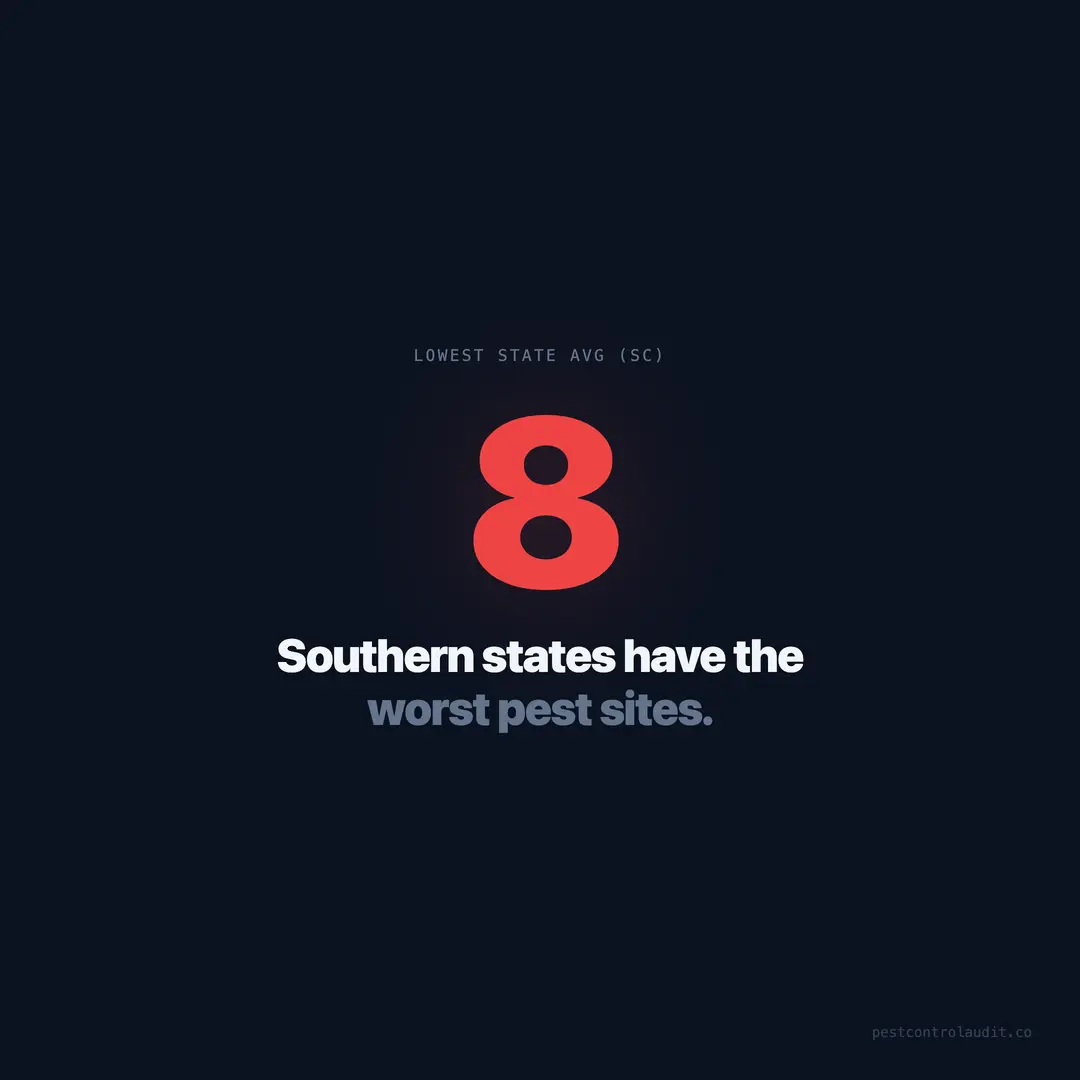
We scored pest control sites across 12 states. SC averaged 8/100, OK 9, AL 9 — while FL led at 33. Here's the full state-by-state breakdown from 1,537 audits.
A pest control company in Greenville, South Carolina, runs Google Ads targeting “termite treatment near me.” The ad costs $14 per click. Forty people click each month. They land on a website with no pricing, no service pages, and a phone number that isn’t clickable on mobile. Two people call. The rest leave and find a competitor who actually shows up online.
South Carolina isn’t an outlier. It’s the norm across the southern U.S. We audited 1,537 pest control websites across 12 states and scored each one on conversion readiness, trust signals, content depth, technical health, and local SEO. The average score across all sites was 21 out of 100. But the state-level data tells a more damning story — the gap between the best and worst states is enormous, and the worst states are clustered in the Deep South and the lower Plains.
This post breaks down every state in our dataset. Where sites are weakest, what’s causing it, and why geography matters more than you’d expect.
South Carolina, Oklahoma, and Alabama sit at the bottom
South Carolina averages 8 out of 100 across 72 audited sites. Oklahoma averages 9 out of 100 across 62 sites. Alabama averages 9 out of 100 across 67 sites. These aren’t cherry-picked numbers — they represent every pest control website we could find and audit in those states.
The pattern is consistent. These bottom-tier states share a set of structural problems that go beyond any single missing element. Their sites tend to be template-based, rarely updated, and missing the conversion fundamentals that turn website visitors into phone calls.
Here’s a practical comparison. A pest control company in Charleston, SC, with a score of 8 is competing online against companies in Jacksonville, FL, where the average is 33. If a homeowner searches “pest control near me” and sees both sites, the Florida company looks like a legitimate operation. The South Carolina company looks abandoned.
What makes this worse is that these low-scoring states have real pest pressure. South Carolina has heavy termite activity, year-round mosquito seasons, and growing populations in cities like Greenville and Charleston. The demand is there. The digital presence isn’t.
Florida and Texas lead — but “leading” means 33 and 32
Florida tops our state rankings with an average score of 33 out of 100 across 375 audited sites. Texas follows at 32 out of 100 across 347 sites. These are the best-performing states in our dataset — and they’re still failing.
A score of 33 means the average Florida pest control website is missing pricing, has weak or no schema markup, lacks service-specific pages, and often has no clear call-to-action above the fold. It’s better than South Carolina’s 8, but it’s nowhere close to functional.
Florida and Texas perform better for a few reasons. Both states have larger, more established pest control companies that have invested in marketing. Both have higher competition density — Florida alone accounts for 375 of our 1,537 audited sites (24% of the total dataset). And both have higher customer expectations driven by year-round pest pressure.
But here’s the thing: even in Florida, 35% of pest control sites have no pricing page, and 25% have no contact form. The bar is low everywhere. It’s just slightly less low in the two biggest states.
The full state ranking reveals a clear geographic pattern
Every state in our dataset falls below 35. Not a single state averages above Florida’s 33. The full ranking shows a geographic gradient — coastal states with larger markets score higher, while interior southern states score the lowest.
The six states averaging 11 or below — SC, OK, AL, TN, NC, and GA — account for 522 of 1,537 sites (34% of our dataset). These aren’t small markets. North Carolina alone has 153 audited sites. Georgia has 84. These are states with millions of residents, active pest pressure, and pest control companies that simply haven’t invested in their online presence.
Why interior southern states score so low
The geographic pattern isn’t random. It tracks closely with three factors: market competition density, average business age, and digital marketing adoption.
Competition density drives investment. Florida has 375 pest control companies in our dataset. South Carolina has 72. When competition is fierce, companies invest in differentiation. When competition is sparse, a Yellow Pages listing and a truck with a phone number feels like enough. But homeowners in every state are searching online now — even in South Carolina. The companies that haven’t adapted are losing to the ones in neighboring states that show up in search.
Older businesses are slower to modernize. In our data, the lowest-scoring states have a higher concentration of owner-operated businesses that have been running for 20+ years. These companies built their customer base through referrals and door-to-door sales. Their websites — if they have one — are afterthoughts. A site built in 2014 and never updated scores poorly because the standards have shifted underneath it.
Marketing agencies vary wildly by region. In Florida and Texas, there’s a competitive ecosystem of digital marketing agencies that specialize in home services. In Alabama and Oklahoma, the agency options are thinner, and many pest control companies either built their own site or paid a generalist who didn’t understand conversion.
North Carolina is the biggest missed opportunity
With 153 audited sites and an average score of just 10 out of 100, North Carolina stands out as the most underperforming state relative to its market size. It’s the third-largest state in our dataset by site count, behind only Florida (375) and Texas (347). And yet it scores lower than every state except SC, OK, and AL.
North Carolina’s pest control market is growing fast. Charlotte, Raleigh, and the Research Triangle are among the fastest-growing metro areas in the southeast. New construction means new pest problems — termite pre-treatments, moisture control, carpenter ant infestations in fresh lumber. The demand is there.
But the websites aren’t keeping up. Among the 153 North Carolina sites we audited, the most common gaps mirror the national picture but at even higher rates. Missing pricing pages, absent schema markup, and no dedicated service pages for the pest types that dominate the state — termites, mosquitoes, and fire ants.
A pest control company in Raleigh that builds a proper website — with transparent pricing, service-specific pages, and a clickable phone number — would immediately stand out in a market where the average competitor scores 10. That’s not a marginal advantage. That’s a structural one.
Georgia and Tennessee follow the same broken pattern
Georgia averages 11 out of 100 across 84 sites. Tennessee averages 10 out of 100 across 84 sites. Both states have major metro areas with significant pest pressure — Atlanta and Nashville — but the website quality doesn’t reflect the market sophistication.
Atlanta in particular should score higher. It’s one of the largest pest control markets in the Southeast, with heavy termite and mosquito activity, and a competitive landscape that includes both national chains and independent operators. But the numbers tell a different story. The Georgia average of 11 suggests that even in a competitive metro like Atlanta, most pest control companies are running basic template sites with minimal conversion infrastructure.
Nashville follows the same pattern. Tennessee’s pest control market is driven by termites, rodents, and seasonal mosquito control. The city has been one of the fastest-growing metros in the country for a decade. New residents searching for pest control find websites that look like they were built before those residents arrived.
What separates Georgia and Tennessee from the absolute bottom (SC, OK, AL) is a thin layer of better-performing companies in the major metros. A handful of sites in Atlanta and Nashville pull the average up from single digits to 10-11. But the rural and suburban sites in both states drag the number right back down.
Even the “best” states are failing at the basics
Florida’s average of 33 and Texas’s average of 32 might look respectable compared to South Carolina’s 8. But a score of 33 still means the website is actively losing leads. Consider what the national gap data shows across all 1,537 sites:
- 35% have no pricing page — 535 sites tell visitors nothing about cost
- 27% have no schema markup — 403 sites give search engines no structured data
- 27% have no commercial pest control page — 409 sites ignore an entire revenue stream
- 26% have a phone number mismatch — 386 sites show a different number than Google
- 25% have no blog — 381 sites produce zero content
- 25% have no contact form — 381 sites offer no way to reach out besides calling
- 21% have no CTA — 319 sites don’t tell visitors what to do next
These gaps exist in every state. The difference is degree. In Florida, maybe 25% have no pricing page. In South Carolina, it’s closer to 50%. The problems are the same — they’re just worse in the bottom-tier states.
Does your site have these gaps? There’s one way to find out. Run a free audit and see where you stack up against your state average.
What a 10-point score improvement actually looks like
Going from a score of 8 to 18 doesn’t require a full redesign. It requires adding the elements that most sites are missing. In practical terms, a 10-point improvement typically means adding three to five conversion elements that were absent before.
Add a pricing page. Even a range-based pricing page (“Termite treatment starts at $300-$600 depending on home size”) eliminates the biggest friction point for 35% of pest control sites. A visitor who sees pricing stays longer and converts at a higher rate than one who sees “Call for a quote.”
Make the phone number clickable. Twenty percent of sites in our audit have phone numbers that aren’t tappable on mobile. A homeowner who finds a spider nest at 9 PM wants to tap a number and call. If your phone number is an image or plain text, they’re tapping the back button instead.
Add schema markup. Twenty-seven percent of sites have none. Schema tells search engines what your business does, where you operate, and what services you offer. Adding LocalBusiness schema with service types takes an hour and improves search visibility immediately.
Install analytics. Twenty-one percent of sites can’t track anything — not visits, not calls, not form submissions. You can’t improve what you can’t measure. Free tools like Google Analytics give you the baseline data needed to understand what’s working.
Add service-specific pages. Twenty-three percent of sites have no rodent page. Twenty-seven percent have no commercial page. Each service page is a new entry point from search. A “Termite Treatment in [City]” page captures searches that your homepage never will.
The competitive advantage is enormous in low-scoring states
Here’s what the data really means for a pest control company in South Carolina, Oklahoma, or Alabama: the bar is on the floor. In a state where the average website scores 8 out of 100, a site scoring 40 doesn’t just look better — it looks like a completely different category of business.
In Florida, you need a site scoring 60+ to stand out from the pack. In South Carolina, you need a site scoring 25. The investment required to reach 25 is a fraction of what it takes to reach 60. We’re talking about basic conversion elements — pricing, forms, clickable phones, service pages — not custom design or advanced SEO.
The companies that move first in these low-scoring states will dominate local search before their competitors even realize there’s a race happening. That window won’t stay open forever. As populations grow in the Carolinas, Tennessee, and Georgia, the marketing sophistication will catch up eventually.
But right now, today, in March 2026? A pest control company in South Carolina that builds a functional website is bringing a gun to a knife fight. And the data proves it.
Keep reading
Want to know your score?
Drop your URL — full report in 48 hours.
We're on it.
Report in your inbox within 48 hours.