Website vs Social Media: Where Should Pest Control Companies Invest?
70-80% of pest control leads originate from search, not social media. Our audit of 1,537 sites shows most can't convert even the traffic they have. Here's where to invest.
A pest control company in Nashville posts twice a week on Facebook. Before-and-after termite damage photos. Quick tips about ant prevention. Occasional coupons for new customers. The posts get 15-30 likes each. Zero of those likes become phone calls. Meanwhile, their website — the place where homeowners actually go when they need pest control — has no pricing, no contact form, and a phone number buried in the footer.
The social media content looks productive. The website looks neglected. This is the wrong allocation of time and money, and it’s happening at pest control companies everywhere.
We audited 1,537 pest control websites across 12 states. The average site scored 21 out of 100, with 61% scoring below 20. Before any pest control company debates whether to post more on Instagram or build out their Facebook page, the data says they should fix the website that’s failing to convert the visitors who are already showing up.
Websites convert intent — social media builds awareness
The core difference between a website and social media isn’t reach or engagement. It’s where the customer is in the buying process. Someone searching “pest control near me” on Google has intent — they have a problem right now and want to hire someone today. Someone scrolling past a pest control post on Facebook is browsing. They might need pest control eventually. The conversion gap between these two moments is enormous.
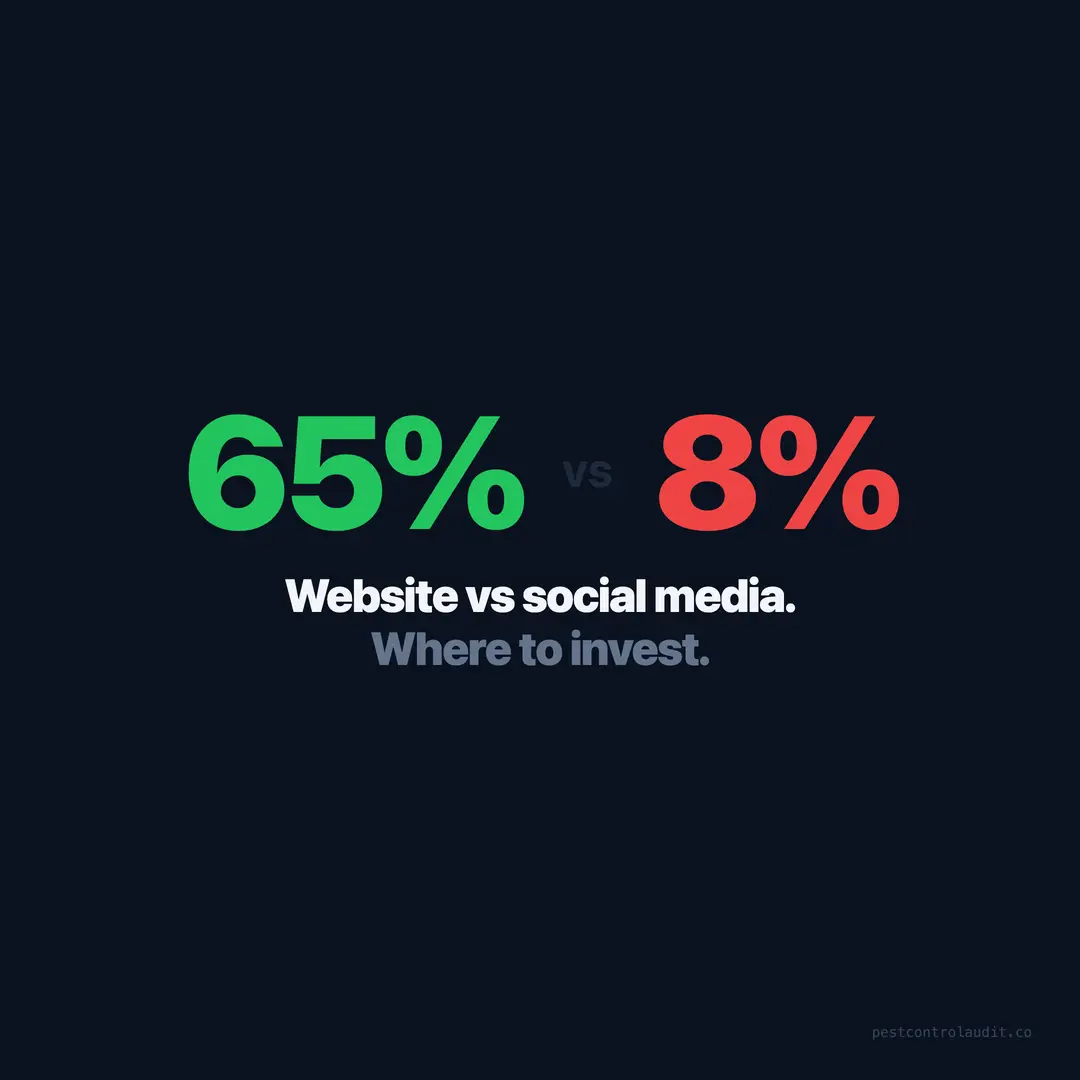
Industry data consistently shows that 70-80% of home service leads originate from search — either Google Search, Google Maps, or direct website visits. Social media accounts for 5-12% of leads in the typical pest control business, with the rest coming from referrals, Nextdoor, and yard signs.
That doesn’t mean social media is worthless. It builds brand recognition that influences the search moment later. A homeowner who saw your Facebook post three months ago might recognize your name in search results and click. But the actual conversion — the moment they decide to call or fill out a form — happens on your website. And if that website scores 21 out of 100, the social media awareness you built gets wasted.
Most pest control websites can’t convert the traffic they already have
Here’s the uncomfortable truth behind the website-vs-social debate: most pest control companies are investing time in social media to drive awareness while their website — the primary conversion tool — is broken.
Across our 1,537 audited sites, the conversion infrastructure gaps are severe:
- 35% have no pricing page — visitors can’t evaluate cost without calling
- 25% have no contact form — the only conversion path is a phone call
- 21% have no CTA above the fold — visitors don’t know what to do
- 20% have non-clickable phone numbers — mobile users can’t tap to call
- 19% have no HTTPS — browsers show “Not Secure” warnings
A social media strategy that drives visitors to a website with these gaps is a funnel that leaks at the bottom. The awareness is there. The conversion isn’t. Fixing these gaps on the website produces more leads than any amount of social media posting because it captures intent-driven visitors who are already looking to hire.
The pest control company that posts twice a week on Facebook but has no contact form is spending hours creating content for an 8% channel while ignoring the 65% channel that’s actively losing leads.
Social media works best for repeat and referral — not first contact
Where social media genuinely helps pest control companies is in maintaining relationships with existing customers and generating referrals. A homeowner who already used your service follows your Facebook page. When their neighbor mentions a mouse problem, your company comes to mind because they saw your post yesterday.
This is awareness-to-referral, not awareness-to-conversion. The social post doesn’t directly generate the lead. It keeps your brand visible so that when a referral opportunity arises, your name surfaces first.
For this to work, though, the referred prospect still ends up on your website. Their neighbor says, “We used ABC Pest Control, they were great.” The prospect Googles “ABC Pest Control,” finds your site, and either calls or doesn’t based on what they see. If the site scores 21 out of 100, the referral dies on the landing page.
This is why owning your website matters more than renting attention on platforms. Social media supports the sale. The website closes it.
The time allocation problem
A pest control company owner or office manager has limited hours each week for marketing. The question isn’t whether social media or a website matters more in theory — it’s which one deserves the next hour of your time.
If your website scores below 30 — and 61% of pest control sites score below 20 — the answer is obvious. Spend the next 10 hours on your website. Add a pricing page. Install a contact form. Make the phone number a clickable link. Add service pages for your top three pest types. Enable HTTPS.
Those 10 hours will produce more leads than 10 hours of social media content creation because they fix the tool where 65% of your leads originate. The social media content can wait. The broken website can’t.
After the website is functional — scoring 40+ with conversion elements in place — social media time becomes productive. You’re building awareness that funnels into a site that can actually capture it. Before that point, social media creates awareness that leads nowhere.
Facebook and Instagram don’t own pest control search intent
When someone has a cockroach infestation, they don’t open Instagram. They open Google. When someone notices termite damage in their garage, they don’t scroll Facebook. They search “termite treatment near me.” Social platforms are where people discover brands passively. Search is where people find solutions actively.
This distinction matters because it determines where your marketing dollar produces the highest return. A dollar spent fixing your website improves the experience for every high-intent visitor who arrives through search. A dollar spent on social media reaches people who aren’t looking for pest control right now and might not look for months.
27% of pest control sites have no commercial pest control page — 409 sites that can’t capture commercial leads at all. A restaurant manager searching for commercial pest control isn’t going to find you on Facebook. They’re going to search, find your website (or not), and make a decision based on what they see (or don’t see). No commercial page means no commercial leads.
Platform dependency is a business risk
Here’s something pest control company owners rarely consider: you don’t own your Facebook page. Facebook does. Their algorithm decides who sees your posts. Their policy changes can reduce your reach overnight. Their platform could deprioritize business pages tomorrow — and there’s nothing you could do about it.
Your website, on the other hand, is yours. You control the content, the design, the conversion flow, and the data. Search engines can change their algorithms, but a well-built website with strong fundamentals adapts. A Facebook page has no such resilience.
We’ve seen this play out already. Facebook organic reach for business pages dropped from roughly 16% in 2012 to under 2% in 2024. Companies that built their customer acquisition entirely on Facebook had to rebuild from scratch — or start paying for ads on the platform they used to reach for free.
A pest control company that depends on social media for leads is renting. A pest control company that invests in its website is owning. The ROI difference compounds every year.
The right allocation: 80% website, 20% social
For a pest control company with a limited marketing budget, the data supports a clear split: put 80% of your marketing time and money into your website and search presence, and 20% into social media.
That 80% covers:
- Website fixes (conversion elements, speed, security)
- Service-specific content pages
- Location pages for every city you serve
- Google Business Profile optimization
- Blog content targeting pest-related searches
- Basic SEO and schema markup
That 20% covers:
- Posting 2-3 times per week on Facebook
- Sharing job photos and customer results
- Responding to comments and messages
- Occasional seasonal promotions
This isn’t a permanent ratio. Once your website scores 60+ and ranks organically for your core terms, you can shift more attention to social. But for a pest control company with a site scoring 21 out of 100, the website is where the money is — and where it needs to go first.
The bottom line
Social media is a tool. Your website is the foundation. You can’t build a successful social presence on a broken foundation. The data from 1,537 audits is unambiguous: the bottleneck for pest control companies isn’t awareness. It isn’t recommendations. It isn’t traffic. It’s conversion. And conversion happens on your website.
Fix the website first. Then use social to amplify what works. Want to see what your website is actually doing with the traffic it already gets? Run a free audit and find out.
Keep reading
Want to know your score?
Drop your URL — full report in 48 hours.
We're on it.
Report in your inbox within 48 hours.