23% Have No Rodent Control Page
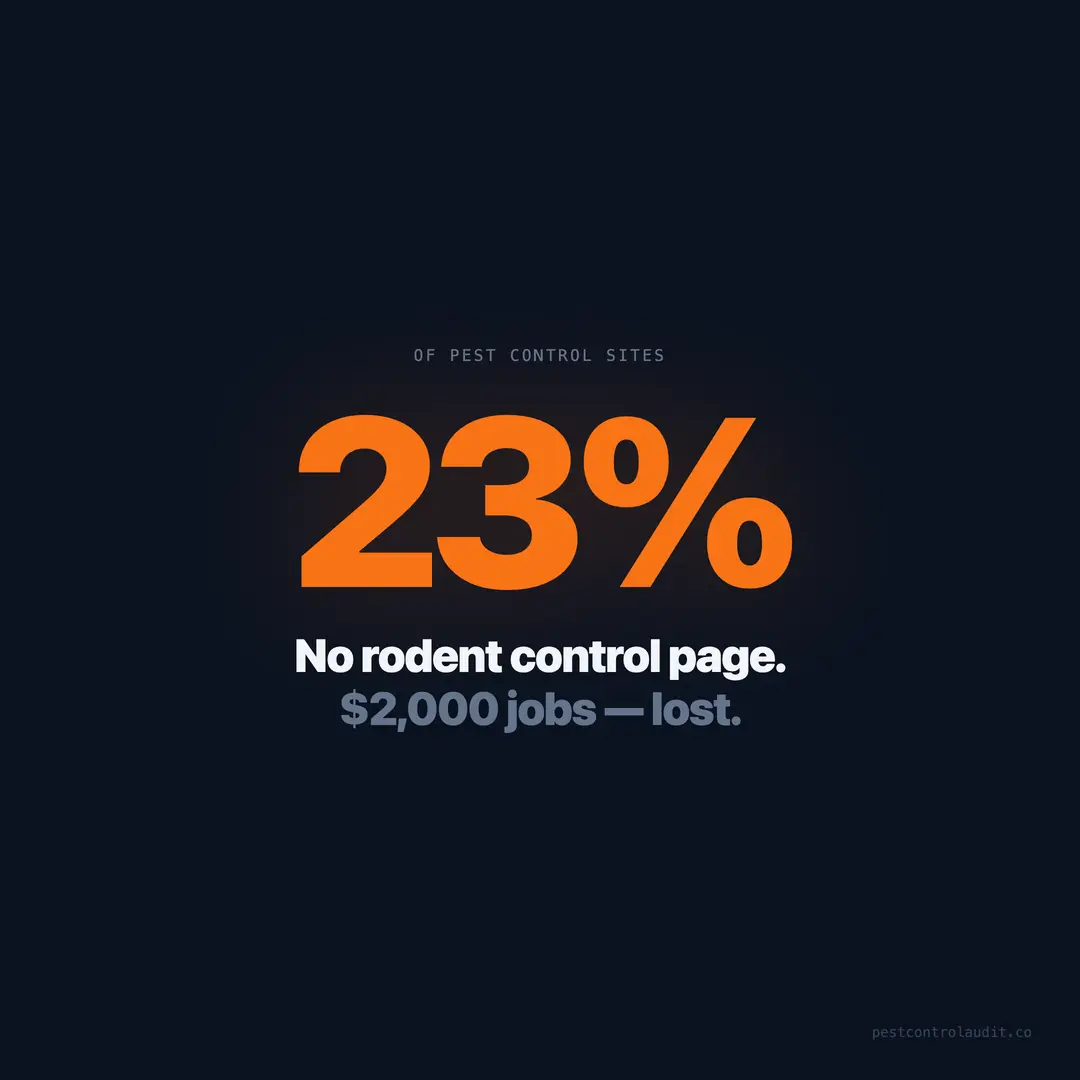
350 of 1,537 pest control sites have no dedicated rodent page. Rodent exclusion jobs run $500–$2,000 — and these companies are invisible for every one of those searches.
A homeowner in Phoenix hears scratching in her attic at 11 PM. She grabs her phone and searches “rodent removal near me.” Three companies show up on page one. Yours isn’t one of them. Not because you don’t offer rodent control — you do, and you’re good at it. But your website has no dedicated rodent control page. Google doesn’t know you offer the service because you never told it.
When we audited 1,537 pest control websites, 350 of them — 23% — had no dedicated rodent control page. These companies offer the service. They do the work. But online, they’re invisible for one of the highest-value services in pest control. Rodent exclusion jobs typically run $500–$2,000, and every missed search is a missed payday.
The average pest control site scores just 21 out of 100. Missing service pages are a major reason. When you don’t have a page for a service you offer, you forfeit every organic search, every Google Ads match, and every local map result for that service.
Missing service pages are an industry-wide problem
Rodent control isn’t the only gap. Across 1,537 audited sites, dedicated service pages are missing at alarming rates for high-value services. 27% have no commercial pest control page — forfeiting restaurant, warehouse, and property management contracts worth $200–$2,000 per month in recurring revenue.
The pattern is consistent: companies list all their services on a single “Services” page with bullet points, or they mention rodent control in a paragraph on their general pest page. Neither approach works for search engines. Google ranks individual, detailed pages — not bullet points buried inside a generic list.
When someone searches “mouse removal [city]” or “rat exterminator near me,” Google looks for the page that most closely matches the query. A dedicated rodent control page with 500+ words, local service area details, pricing guidance, and customer reviews will outrank a competitor’s generic services page every time.
Think about it from the customer’s perspective. Would you trust a company whose website says “We handle rodents” in a bullet point, or one with a full page explaining their exclusion process, showing before-and-after photos, and listing starting prices? The homeowner with rats in her attic wants specifics, not a menu.
A bullet point is not a page
The most common mistake we see: a pest control website with one “Services” page listing every service in a bulleted list. General pest control, termite, rodent, bed bugs, mosquitoes, commercial — all on one page with a sentence or two each.
This approach fails for three reasons:
Google can’t rank a bullet point. Search engines rank pages, not list items. When someone searches “rodent control [city],” Google won’t surface your services page because it isn’t about rodent control — it’s about everything. A competitor with a dedicated 600-word rodent page will outrank you every time.
Visitors can’t find what they need. A homeowner with a mouse problem doesn’t want to read through your termite and mosquito offerings to find the rodent section. She wants a page that speaks directly to her problem: what you do, how you do it, how much it costs, and how fast you can get there.
You can’t run targeted ads. If you’re running Google Ads for “rat removal near me,” you need a landing page about rat removal. Sending that ad traffic to a generic services page with 8 bullet points kills your conversion rate and inflates your cost per lead.
What a strong rodent control page includes
The pest control sites that rank for rodent-related searches share common elements. The page needs enough depth that Google treats it as the definitive local resource for rodent control.
Service-specific headline with city
“Rodent Control in [City] — Fast, Licensed, Guaranteed.” The headline tells the searcher and Google exactly what this page is about. Include your primary city and state. If you serve multiple cities, build service area pages that reference this main rodent page.
Detailed service description (300+ words)
Explain your rodent control process. What does an inspection involve? How do you identify entry points? What exclusion methods do you use? Do you offer trapping, baiting, exclusion, or all three? Homeowners searching for rodent control are anxious — they want to know you have a clear process.
Pricing guidance
Even a range helps. “Rodent exclusion typically costs $500–$2,000 depending on home size and number of entry points.” The 35% of pest control sites with no pricing page lose visitors who want a ballpark before calling.
Reviews from rodent control customers
Embed 3–5 Google reviews that specifically mention rodent work. “They sealed every entry point — no more mice” is more powerful than a generic “great service” review. Service-specific social proof converts browsers into callers.
A clear CTA matching the intent
“Schedule Rodent Inspection” — not generic “Contact Us.” The CTA should match what the visitor came to do. A specific button converts better because it confirms the visitor is in the right place.
The revenue you’re forfeiting
Rodent control is one of the most profitable services in pest control. The numbers tell the story:
Average rodent exclusion job: $500–$2,000. That’s 3–10x the revenue of a standard general pest treatment. One missed rodent lead per week at $750 average ticket costs you $3,000 per month and $36,000 per year in lost revenue.
Rodent searches spike in fall and winter. When temperatures drop, rodents move indoors. Search volume for “mouse removal” and “rat exterminator” jumps 40–60% between October and February. Companies without a rodent page miss this entire seasonal surge.
Rodent customers become recurring customers. A homeowner who hires you for rodent exclusion is a strong candidate for a quarterly pest prevention plan. The lifetime value of a rodent customer often exceeds $3,000 over three years.
Without a dedicated page, you’re invisible for all of it. The homeowner searches, finds three competitors, picks one, and you never knew the lead existed.
How this connects to your other gaps
Missing a rodent page rarely exists in isolation. In our audit data, sites without a rodent page also tend to have these problems:
No commercial pest page — 27% of audited sites skip commercial services entirely, forfeiting restaurant, hotel, and property management contracts.
No service area pages — 22% of sites have no city-specific pages, which means they compete for broad regional terms instead of dominating their local market.
No schema markup — 27% skip schema entirely, which means Google has less structured data to work with when deciding which sites to feature for local searches.
These gaps compound. A site missing a rodent page, commercial page, service area pages, and schema is invisible across multiple high-value search categories. The fix isn’t complicated — it just takes building the pages.
Build the page this week
A dedicated rodent control page takes 2–4 hours to write and publish. It doesn’t need to be perfect — it needs to exist. A basic 500-word page with your process, a price range, a few reviews, and a clear CTA will outperform having no page at all.
Start with rodent control because the ticket size justifies the effort immediately. Then build pages for every other service you offer: termites, bed bugs, mosquitoes, commercial, wildlife. Each page you add captures a new category of searches you’re currently missing.
23% of your competitors have the same gap. But the other 77% have rodent pages — and they’re getting the calls you’re not. Every week without a dedicated page is another week of forfeited revenue.
Want to see exactly which service pages your site is missing? Run your free audit — we’ll score your site and show you every gap.
Keep reading
Want to know your score?
Drop your URL — full report in 48 hours.
We're on it.
Report in your inbox within 48 hours.