Customers Can't Find Your Pest Control Services Online
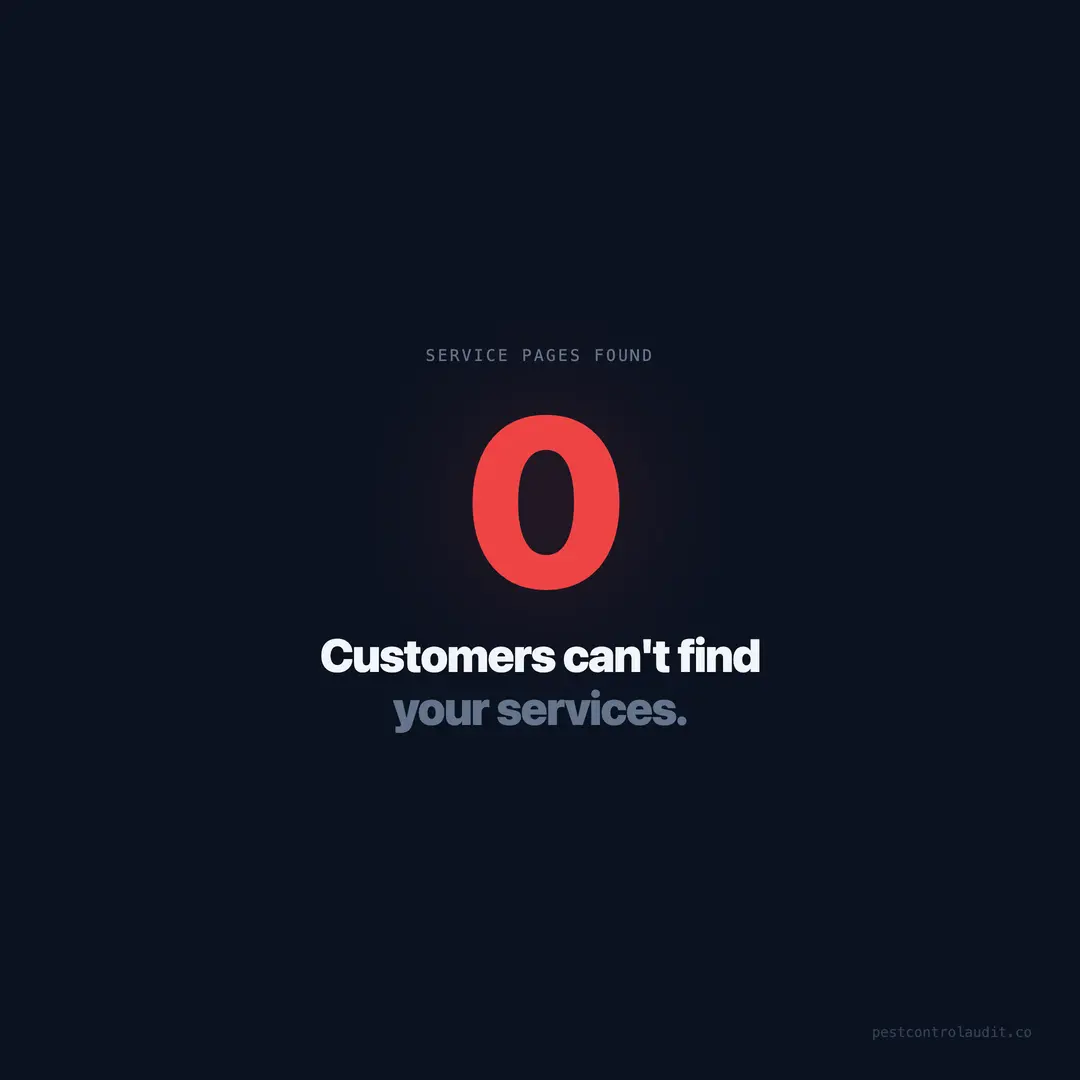
23% of pest control sites have no rodent page. 27% skip commercial services. 22% have no service area pages. If the page doesn't exist, the customer can't find you.
You offer termite inspections, rodent exclusion, commercial pest management, and mosquito treatments. But a homeowner searching for any of those services in your city can’t find you. Not because you don’t do the work — because your website never mentions it in a way Google can surface.
When we audited 1,537 pest control websites, we found massive gaps in service page coverage. 23% have no rodent control page. 27% have no commercial pest control page. 22% have no service area pages at all. These companies offer the services — but online, they don’t exist for the customers searching for them.
The average pest control site scores 21 out of 100. Missing service pages are a primary driver. Google can’t rank a page that doesn’t exist. If you don’t have a page for termite inspection, you’re invisible for every “termite inspection [city]” search.
The single services page problem
The most common setup we see: one page titled “Services” or “Our Services” with a bullet list of everything the company offers. General pest control, termite, rodent, bed bugs, commercial, wildlife — all crammed into a single page with a sentence or two per service.
This approach fails in three ways:
Google can’t rank a list item. Search engines rank individual pages for specific queries. When someone searches “bed bug treatment [city],” Google looks for the page most relevant to that exact topic. A generic services page that mentions bed bugs in one bullet point loses to a competitor’s dedicated 600-word bed bug treatment page every time.
Visitors can’t find the service they need. A homeowner with a rat problem doesn’t want to scroll through your termite, ant, and mosquito sections looking for the rodent part. She wants a page that addresses her problem directly: what you do about rats, how fast you can get there, and what it costs.
You can’t target ads effectively. Running Google Ads for “rodent removal near me” and sending traffic to a generic services page with 10 bullet points is a recipe for wasted ad spend. A landing page specifically about rodent removal converts 2–3x higher.
The specific pages your site is probably missing
Based on our audit of 1,537 pest control sites, these are the most commonly missing service pages — ranked by how much revenue they forfeit:
Rodent control (missing on 23%)
350 companies have no dedicated rodent page. Rodent exclusion jobs run $500–$2,000. That’s 3–10x the revenue of a standard general pest treatment. Searches for “mouse removal,” “rat exterminator,” and “rodent control” spike 40–60% in fall and winter. Missing this page means missing an entire high-value seasonal surge.
Commercial pest control (missing on 27%)
409 companies have no commercial page. Restaurant, hotel, warehouse, and property management contracts are worth $200–$2,000 per month in recurring revenue. A single commercial account can be worth more annually than dozens of one-time residential treatments. But without a dedicated page explaining your commercial services, property managers searching online will never find you.
Service area pages (missing on 22%)
327 companies have zero city-specific pages. If you serve 15 cities but your website only mentions your headquarters city, you’re invisible in 14 of them. When someone in a suburb 20 miles away searches “pest control in [suburb name],” your homepage targeting your main city won’t appear.
Building service area pages is one of the highest-ROI activities in local SEO. Each page targets a specific city or neighborhood, capturing searches you’re currently forfeiting to competitors who built theirs.
Each missing page is a forfeited search category
Google organizes search results by topic. “Pest control [city]” is one category. “Termite inspection [city]” is another. “Rodent removal [city]” is another. “Commercial pest control [city]” is another. Each of these categories has its own search volume, its own competition, and its own results page.
If you have one page — your homepage — you can compete in one category. Your competitor with 20 pages competes in 20 categories. They capture searches for termite inspections, rodent problems, bed bug treatments, mosquito control, commercial services, and every city they serve. You capture searches for your company name and maybe “pest control [main city].”
The difference is enormous. A pest control site with 20 dedicated pages typically gets 5–10x more organic search traffic than one with a single services page. That’s 5–10x more visitors who found you through a search they initiated — the highest-intent, highest-converting traffic available.
What each service page needs
Every dedicated service page should include these elements:
Service-specific headline with location. “Termite Inspection in [City] — Licensed, Insured, Same-Day Available.” Tell the searcher and Google exactly what this page is about.
Detailed description (400–600 words). Explain your process for this specific service. What does the inspection or treatment involve? How long does it take? What should the customer expect? Homeowners are anxious when pests invade — detailed descriptions build confidence.
Pricing guidance. Even a range helps. “Termite treatment typically costs $800–$2,500 depending on infestation severity and home size.” The 35% of sites with no pricing information lose visitors who want a ballpark before calling.
Service-specific reviews. 3–5 reviews from customers who used this specific service. “They found termites in our garage and had it treated within 48 hours” is more persuasive than “Great company, highly recommend.”
CTA matching the service. “Schedule Termite Inspection” — not generic “Contact Us.” Specific CTAs confirm the visitor is in the right place.
Local signals. Mention neighborhoods, zip codes, and common pest issues in the area. “Subterranean termites are especially common in [neighborhood] due to the area’s clay soil and older construction.”
The seasonal opportunity you’re missing
Different pest services have distinct seasonal search patterns:
- Rodent control spikes October through February as temperatures drop
- Termite searches peak March through June during swarming season
- Mosquito control surges April through September
- Bed bug searches are consistent year-round but spike after summer travel
Without dedicated pages for each service, you miss every seasonal surge. The homeowner who sees termite swarmers in April searches “termite inspection [city]” and finds three competitors — none of which are you. By the time general pest season arrives, she’s already under contract with someone else.
Commercial services are the biggest missed opportunity
27% of pest control sites have no commercial pest control page. This is arguably the most expensive gap in the entire audit. A single commercial account — a restaurant, hotel chain, or property management company — can be worth $2,400–$24,000 per year in recurring revenue.
Property managers searching “commercial pest control [city]” need to see a page that addresses their specific concerns: compliance, multi-unit service, documentation, emergency response times, and contract terms. Your residential-focused homepage doesn’t speak to any of that.
Building a commercial page takes a single afternoon. Include your experience with commercial properties, the types of businesses you serve, your inspection and reporting process, and a CTA like “Request Commercial Quote.” That single page opens an entire revenue category that 27% of your competitors are also ignoring.
The fix is straightforward
Here’s the page-building priority based on revenue impact:
Week 1: Commercial pest control page. Highest recurring revenue per account. One page, 500–700 words, targeting “commercial pest control [city].”
Week 1: Rodent control page. Highest ticket size for residential. 500–700 words targeting “rodent removal [city]” and “mouse exterminator [city].”
Week 2: Termite page. If you don’t have one already. High urgency, high ticket, strong seasonal volume.
Week 2: Bed bug page. Consistent year-round demand, high anxiety, high willingness to pay.
Week 3–4: Service area pages. One page per city you serve. 400–600 words each with unique local details.
Total investment: 2–4 weeks of focused content creation. Each page you publish immediately becomes eligible for Google indexing and ranking. Most pages start appearing in search results within 4–8 weeks of publication.
Every page you build captures a search category you were forfeiting. Every search category you capture becomes a source of leads your competitors can’t take from you.
Want to see which pages your site is missing? Run your free audit — we’ll identify every service gap and show you the revenue impact.
Keep reading
Want to know your score?
Drop your URL — full report in 48 hours.
We're on it.
Report in your inbox within 48 hours.